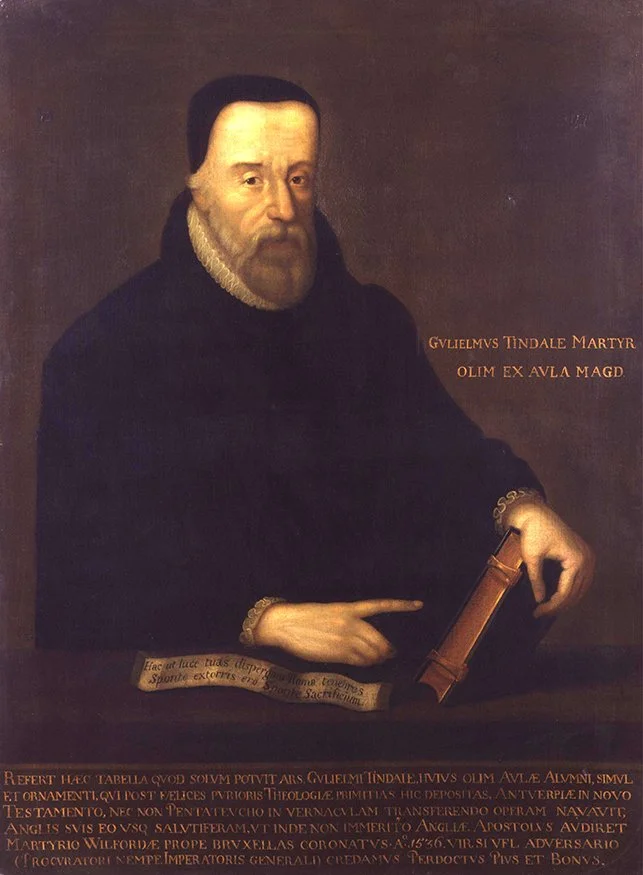
About William Tyndale
Our founding board decided to name the school after William Tyndale, a leading figure in the Protestant Reformation who is regarded as the father of the English Bible. His life and example are celebrated in the following collect, an Anglican prayer traditionally read on October 6, the feast day commemorating his martyrdom:
“Lord, give to your people grace to hear and keep your word that, after the example of your servant William Tyndale, we may not only profess your gospel but also be ready to suffer and die for it.”
Tyndale’s life presents a remarkable example of intellectual and academic excellence integrated with faith in service of God’s kingdom. May the school that bears his name inspire its students to do the same.
In the sixteenth century, William Tyndale sought permission from the Bishop of London to produce an English translation of the Bible but was met with resistance. The religious authorities feared that an English translation would spread Martin Luther’s Protestant doctrines and lead to upheaval similar to what had taken place in Germany.
Tyndale realized he would have to leave England in order to accomplish his goal. Over the following years, living in exile and as a fugitive, he completed the first English translation of the New Testament directly from the Greek and continued working on portions of the Old Testament.
After twelve years in hiding, Tyndale was betrayed in 1535 and taken into custody. Upon his arrest, the bulky manuscript of his most recent translation work — Joshua through II Chronicles — miraculously escaped confiscation. Following his trial in August 1536, he was condemned as a heretic and sentenced to death after asserting, among other things, that justification is by faith alone.
On October 6, 1536, he uttered his final recorded words before being burned at the stake:
“Lord, open the king of England’s eyes.”
God answered Tyndale’s dying prayer. Less than a year after his death, Thomas Cromwell, Henry VIII’s principal advisor, and Thomas Cranmer, the Archbishop of Canterbury, persuaded the king to approve the publication of an official English Bible.
When King Henry saw the Coverdale Bible, he emphatically proclaimed, “If there be no heresies in it, then let it be spread abroad among all the people!”[2] In September 1538, the king issued a decree that a copy of the Bible in English and Latin should be placed in every church in England.
Almost five hundred years later, the river of Scripture continues to flow across the globe.
Tyndale’s translation formed the basis of the King James Version in 1611 and influenced nearly every English translation since. Today, while English translations are numerous, they trace their singular origin to Tyndale’s foundational work. Publishers of English Bibles continue to stand upon the sturdy shoulders of his pioneering efforts.
Footnotes:
[1] Passages herein are adapted and excerpted from The Daring Mission of William Tyndale, Steven J. Lawson (Ligonier Ministries 2015).
[2] William J. McRae, A Book to Die For: A Practical Study Guide on How Our Bible Came to Us (Toronto: Clements, 2002), xiv, cited in Tony Lane, "A Man for All People: Introducing William Tyndale," Christian History 6, no. 4 (1987), 6—9.